
2025/10/31
Takeno Senko Inc. 2025
Layers of Color on a Single Cloth: Pioneering Double-Sided Dyeing in Sakai with a Unique Craftsmanship
For about 80 years in Sakai, Osaka, Takeno Senko Inc. has inherited the technique of roll nassen (roller printing). This technique, which uses rotating cylindrical rollers to apply dyes, is now practiced by only a handful of companies across Japan. Among them, Takeno Senko stands alone as the only one in the country to achieve reversible dyeing—dyeing both sides with different colors and patterns.
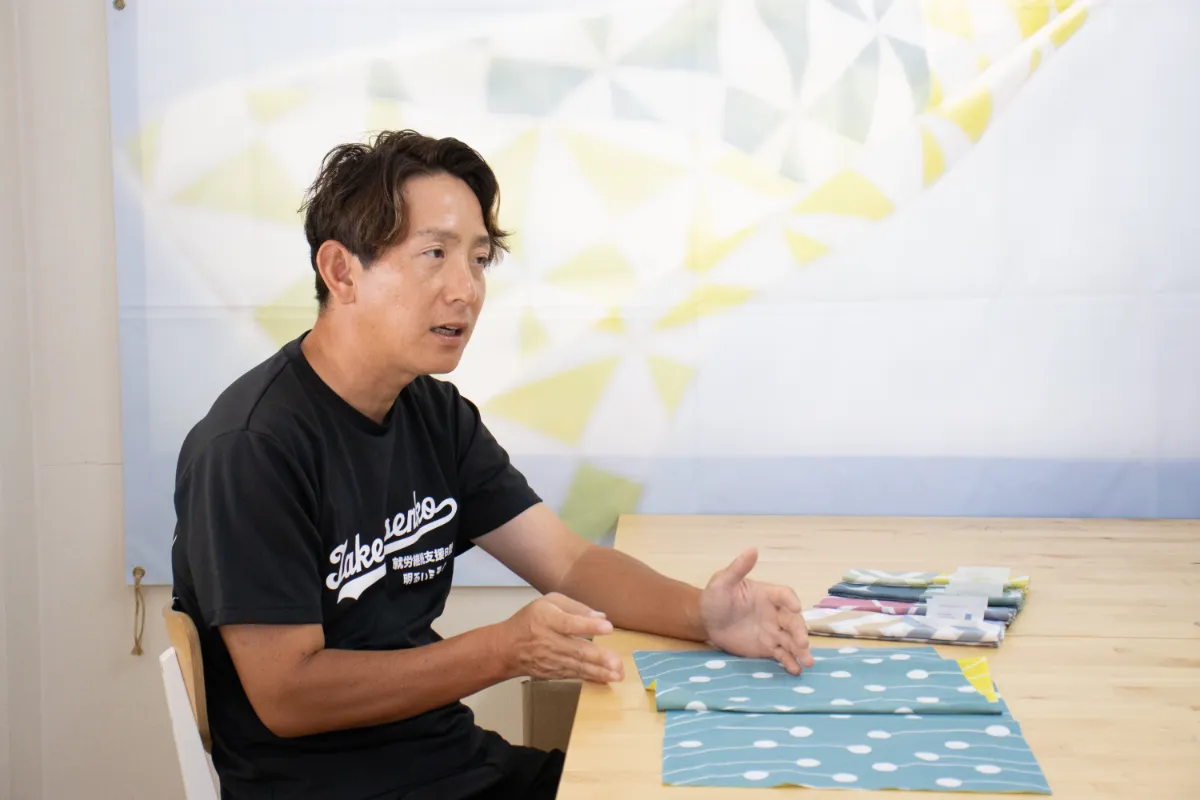
The third-generation president, Hisashi Terada, returned to the family business after working at a travel agency, following the sudden passing of his uncle, the previous president. He took office in 2005 at the young age of 27. At the time, the dyeing industry was in steep decline, and even the wholesalers he worked with told him, “You should give up—it’s only going downhill.”
Despite the grim outlook, President Terada firmly believed, “Our dyeing technique is too precious to lose,” and “I want to preserve the craftsmanship that only our factory can achieve.” Guided by this conviction, he began seeking a path toward renewal.
The idea for reversible dyeing emerged around 2014. While it was theoretically possible, putting it into practice proved challenging. After three years of trial and error with skilled artisans, they launched their original brand <hirali> in 2017—an initiative born out of a desire to protect and evolve their one-of-a-kind technology.
The Artisans’ “One-Shot” Skill and Technical Inheritance
In today’s dyeing industry, screen printing—which requires relatively little artisanal expertise—has become mainstream. In contrast, the roll nassen process, though it appears automated, actually demands the intuition and experience of seasoned craftspeople.
The “blade” is crucial for achieving crisp, defined patterns. Each artisan begins the day by sharpening this custom stainless-steel blade—crafted in-house rather than purchased—balancing sharpness with strength. This process alone can determine the beauty of the final product and requires years to master. It is said to take about three years before a young artisan can sharpen the blade with full confidence.
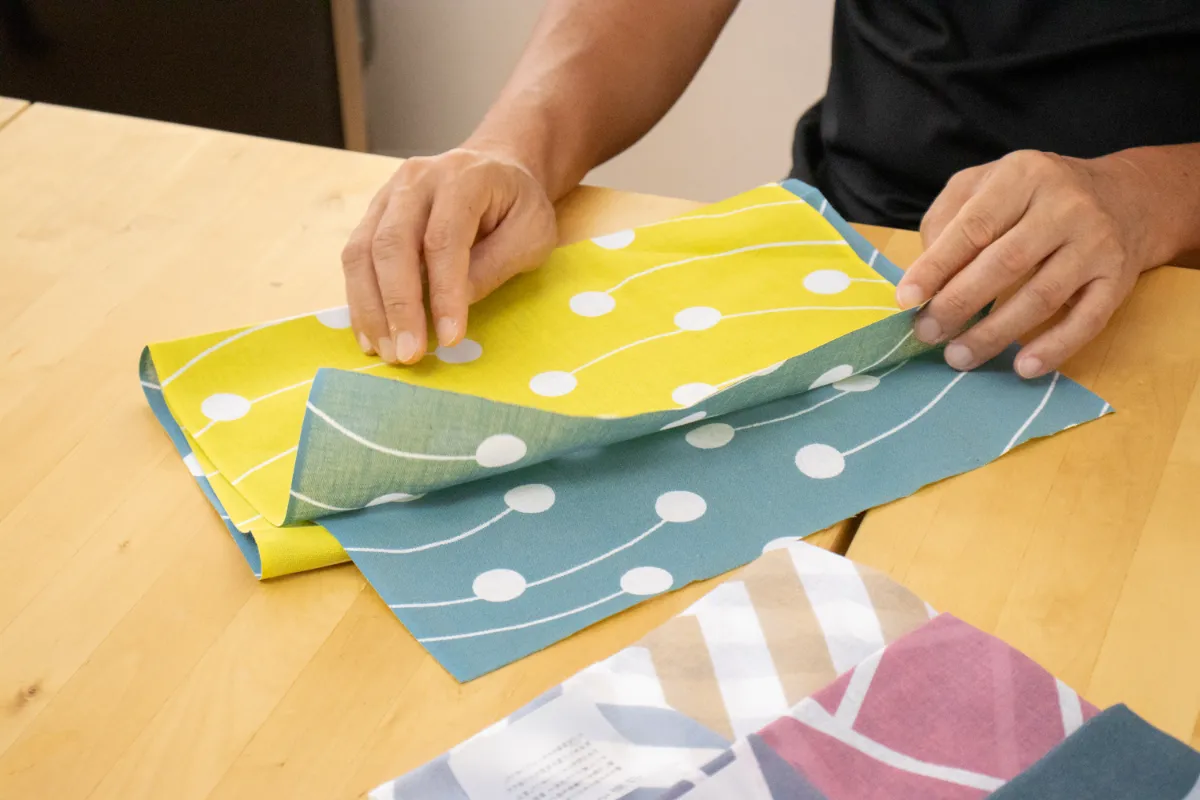
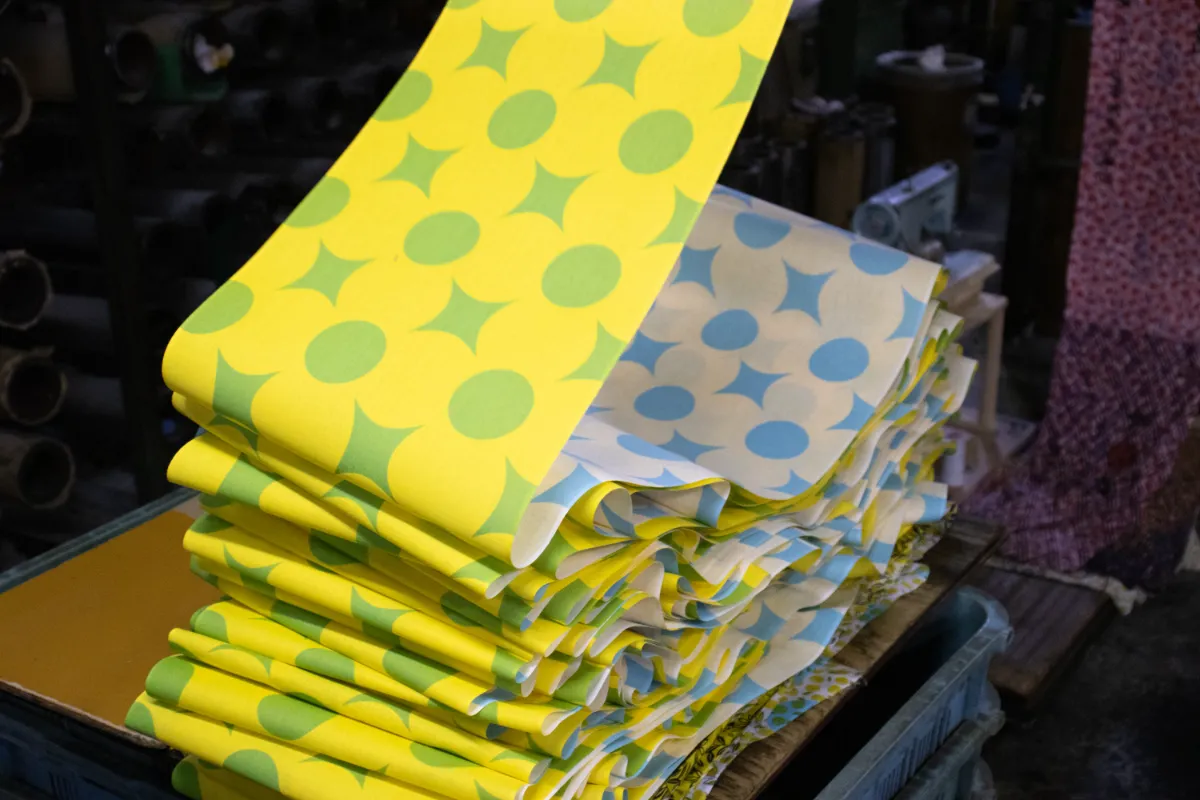
The design of <hirali> draws inspiration from Kasane no Irome—the traditional Japanese art of color layering found in the twelve-layered kimono (Juni-hitoe) of the Heian period. These color combinations, reinterpreted for modern life, are expressed through Takeno Senko’s unique, highly refined double-sided dyeing technique, developed through extensive experimentation and research.
Mr. Katayama, an artisan who has worked on <hirali> since joining the company, explains:
“It’s incredibly difficult to dye both sides beautifully—it’s a one-shot deal. You don’t know if it’s successful until it’s finished.”
The tension of knowing that the slightest misalignment can ruin the pattern, paired with the satisfaction of perfect success, gives this craft its thrill.
The difficulty of double-sided dyeing lies in the interference between the dyes on the front and back. Thin gauze fabrics, such as those used for the certified stoles, amplify this challenge. Artisans make micro-adjustments to the dye absorption rate through their intuition—modifying dye viscosity, adjusting machinery with millimeter precision, and carefully controlling every variable.
To align patterns perfectly, the process involves three dyeing stages and an anti-misalignment step, compared to a single pass in normal dyeing. Afterward, the fabric is steamed in a Kyoto factory to enhance color development. In total, this technique requires four to five times the usual effort. Even now, more than eight years after its commercialization, the team humbly says the technique is “still evolving.”
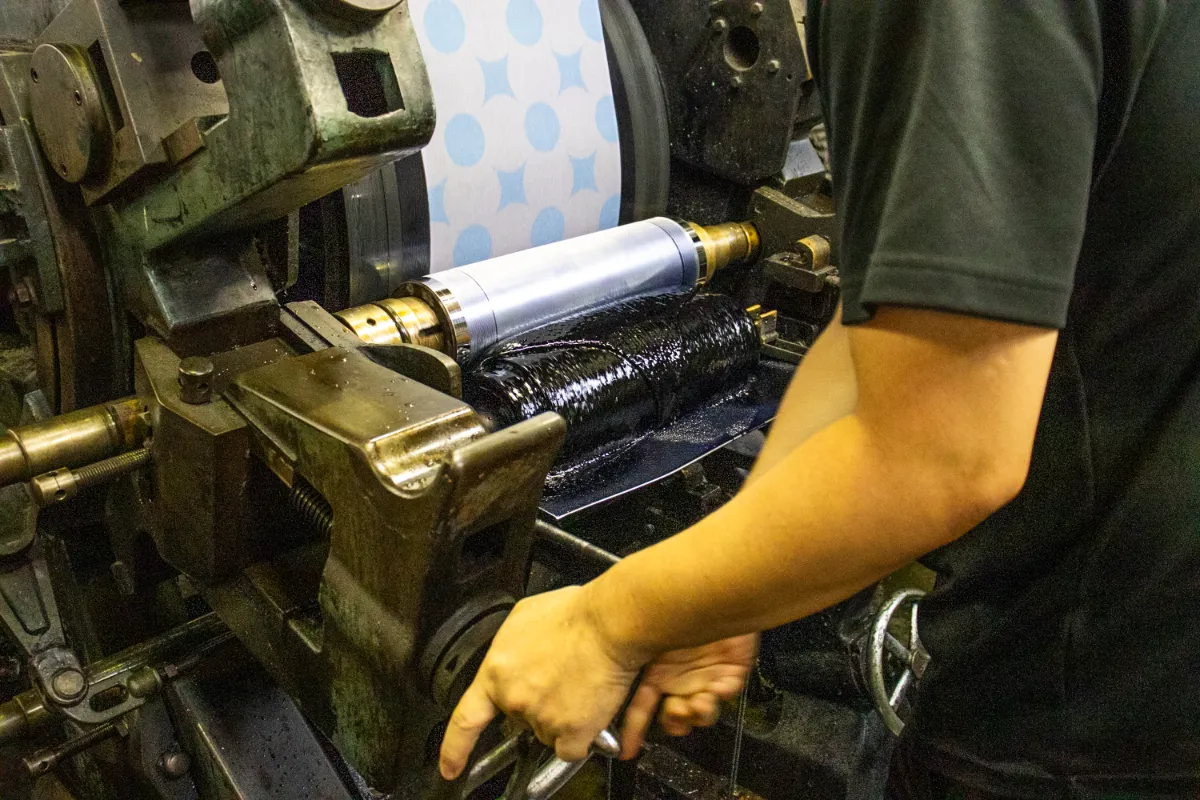
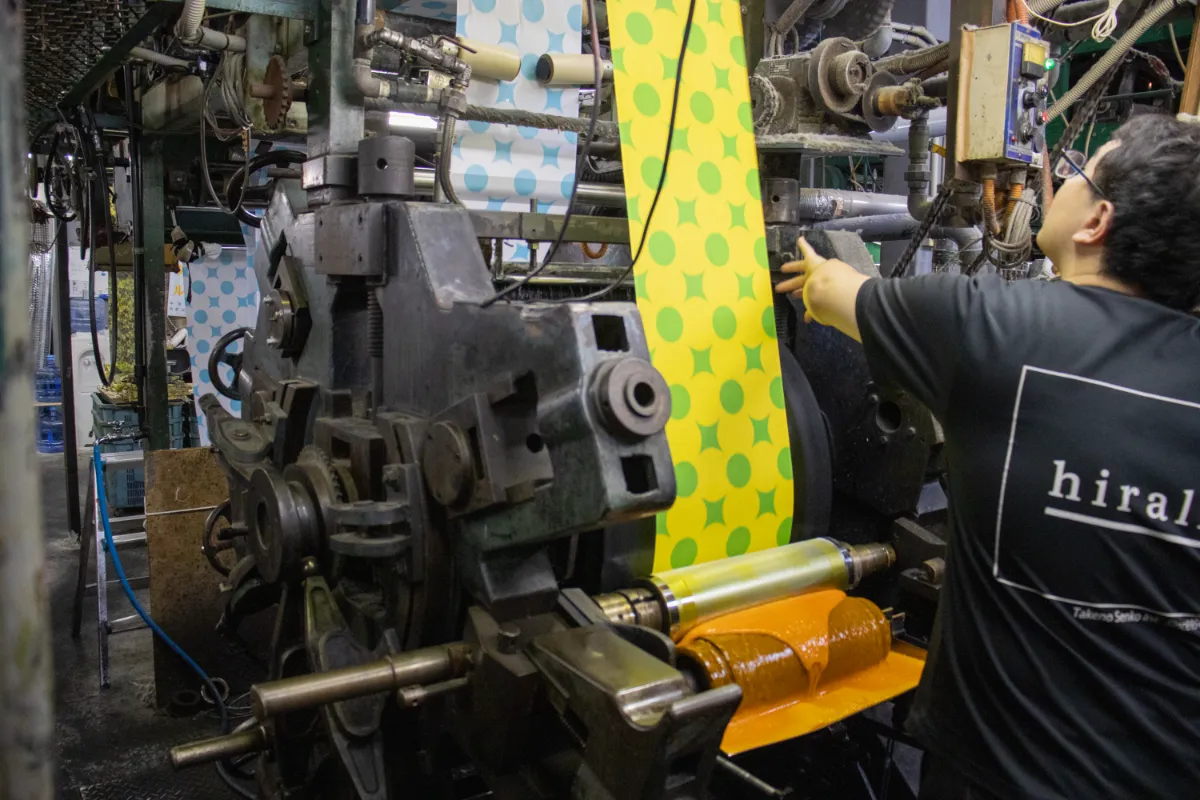
Skill transmission is also a major challenge.
“In a world without manuals, some things can only be learned by watching and repeating,” says one artisan. “Beyond effort, a certain sense is essential.”
Of the three dyeing artisans currently at the company, the two responsible for roll nassen are in their twenties and thirties. Their spirit of friendly competition and dedication to mastering their craft lights the way for the future of this precious art.
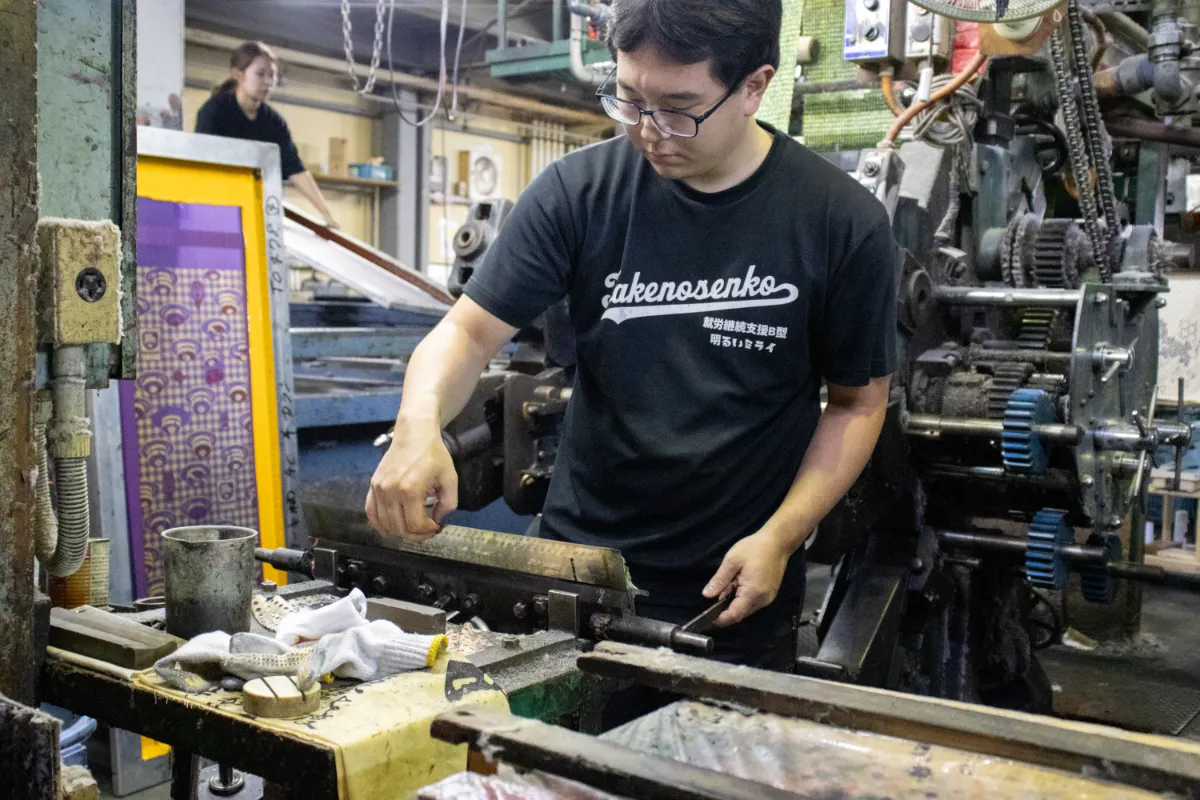
Mr. Yamashita, who joined about a year ago, is a native of Sakai. “I never knew such an amazing technology existed in my hometown,” he says. Now handling one- and two-color designs, he trains daily with the goal of one day being entrusted with a complex four-color design on the large rollers.
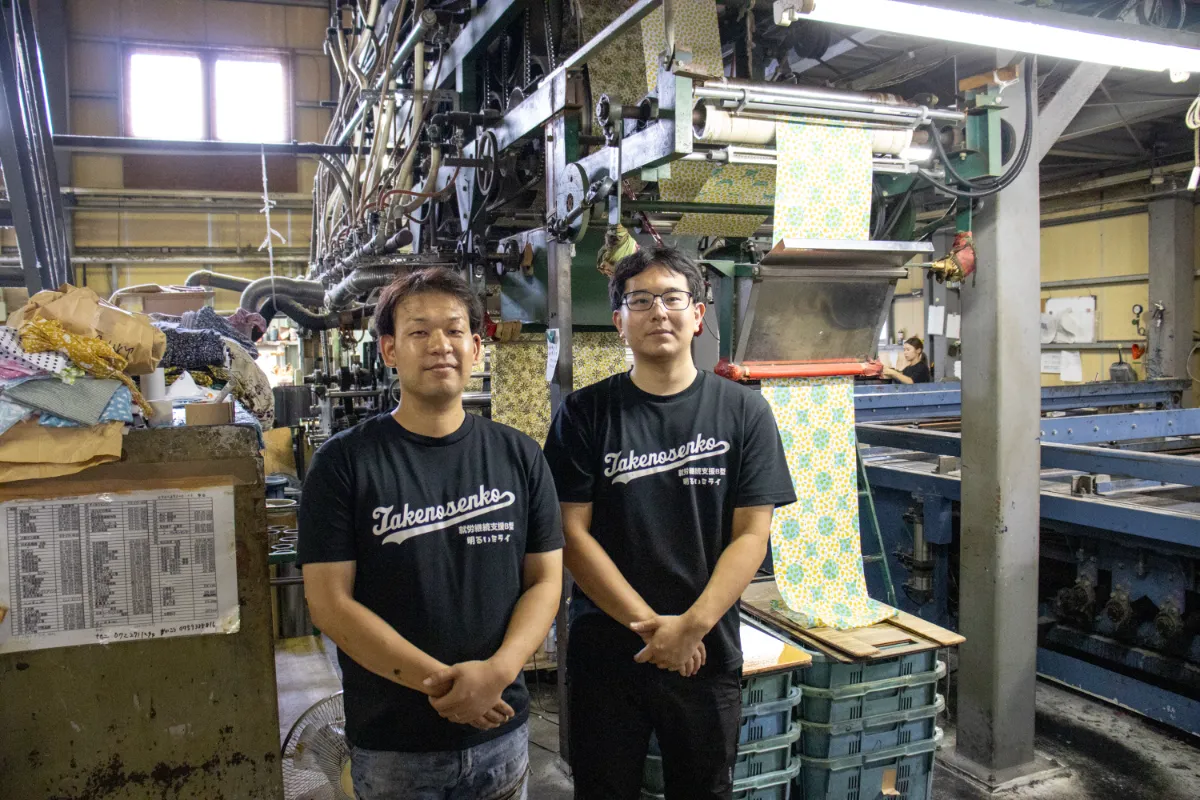
Expanding a Circle of Supporters: Promoting Sakai’s Pride as a “Narrow-Width, Fully Integrated Production Area”
The “narrow-width” (tenugui-width) cotton that Takeno Senko works with is deeply rooted in Sakai’s long history as a production center where wazarashi (traditional bleaching) once flourished. Sakai is the only region in Japan where all processes—from weaving and bleaching to dyeing and finishing—can be completed entirely within the same area.
However, President Terada recognizes a challenge: even local residents are often unaware that Sakai is a “town of tenugui.”
While Sakai is strongly associated with cutlery, the traditional image of tenugui tends to evoke Kyoto instead. With the dream of a day when people naturally say, “Sakai means tenugui,” President Terada continues his efforts to revitalize the region, leveraging its unique strength as Japan’s only “narrow-width, fully integrated production area.”
Akarui Mirai” (Bright Future) – support facility, “continuous support for employment services (Type B)
Alongside this long-term vision, Takeno Senko also operates a Type-B Continuous Employment support workplace, adjacent to its headquarters. This initiative entrusts people with disabilities with folding and cutting tenugui—tasks once handled by older workers before the labor shortage. Around twenty staff members now contribute to the packaging and shipping of <hirali> products.
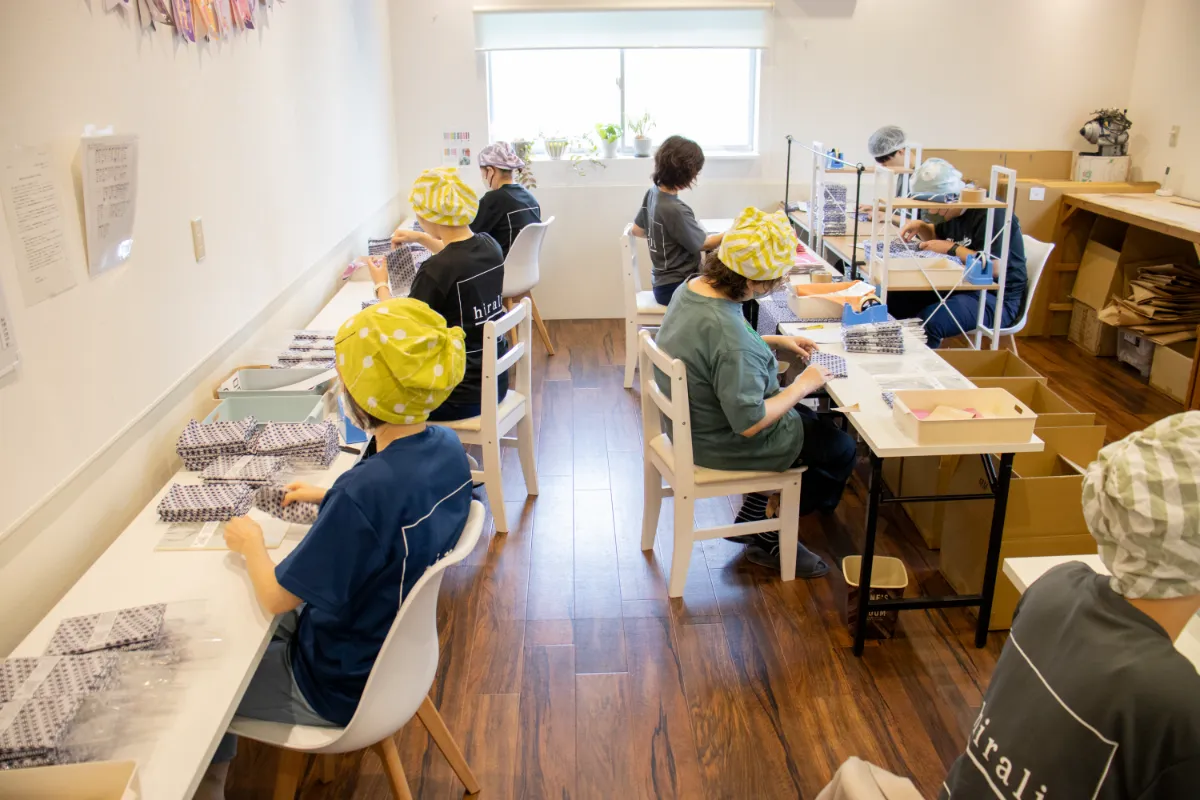
Inside a space that feels like a stylish café, President Terada moves gently among the staff, offering warm words to each person. The atmosphere is filled with trust and kindness.
The <hirali> products created here are sold in department stores and overseas for 2,000–3,000 yen each. Knowing that “what we make here is valued and sold across Japan and beyond” instills deep pride and motivation among the workers.
Weaving the Future of Dyeing from Sakai
Carrying forward the legacy of Sakai’s narrow-width, fully integrated production area—and the roll nassen technique, now one of Japan’s last remaining—Takeno Senko continues to innovate.
Driven by unmatched technical skill and a deep sense of social responsibility, the company’s vibrant colors and heartfelt craftsmanship are dyeing not just cloth, but the very future of Sakai.