2023/10/1
Nakanai Co., Ltd. 2023
A traditional craft representing Sakai, born in a cotton-growing region
Chusen, as the name suggests, is a dyeing technique that involves pouring dye onto the fabric.
One of the appeals of this technique is that a single piece of fabric is folded into an accordion-like pleat and dyed twice—once from the front and once from the back—resulting in the same pattern and color tone on both sides. Additionally, because the dye penetrates the fabric fibers rather than simply sitting on the surface, the finished product is breathable and soft.
This technique, capable of dyeing 50 pieces at once, originated in Osaka during the Meiji era. Sakai was originally a cotton-producing region. To the south lies the Senshu region, famous for its towel production. The area along the Ishizu River, which flows through Kanae-cho in Sakai City, was once known as a center for washi (Japanese paper) production. Even today, with fabric-bleaching factories and weaving mills still operating in the vicinity, it is said to be an ideal environment for producing tenugui. However, the number of small local factories, once numerous, has dwindled to just a handful.
Unique Product Development Combining Tradition and Modern Sensibilities
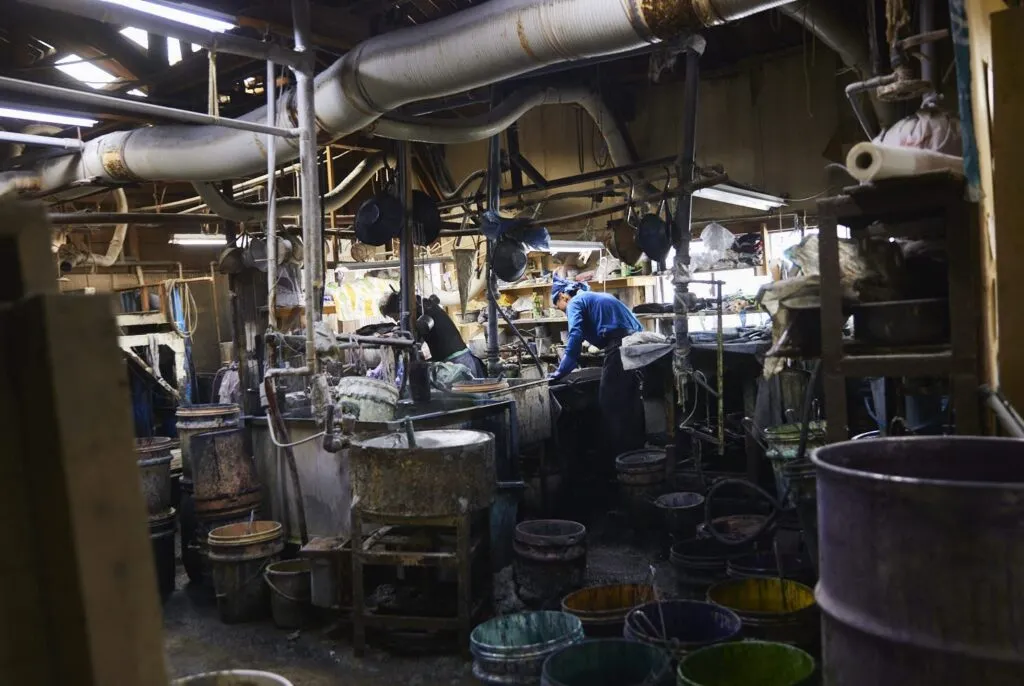
One of the manufacturers preserving this tradition of chusen dyeing is Nakanai Co., Ltd., which has its factory along the Ishizu River. Since its founding in 1966, the company has been known as an industry pioneer, continuously exploring new possibilities for chusen dyeing in line with the times.
“I believe we are the only chusen dyeing factory in Japan that employs in-house designers. We have a wide range of artisans on the production floor, from veterans to young craftsmen, and we actively take on the challenge of creating new tenugui by combining their high-level skills with the designers’ sensibilities.”
These words come from Fumimi Kuma, who oversees product development. Under Kuma’s management, 12 to 13 artisans and two designers work in close collaboration to create items brimming with originality.
The artisans’ high-level skills that make diverse designs possible
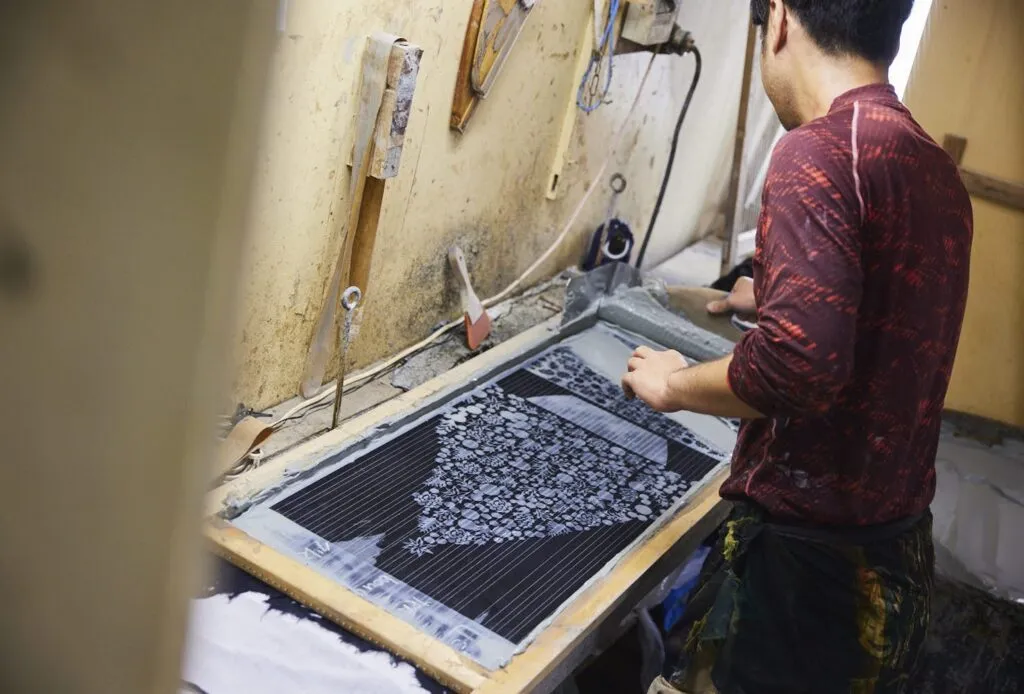
As soon as you step into the factory, a faint scent of the sea wafts through the air. This is the smell of seaweed contained in the paste used for “nori-oki,” the first step in the chusen dyeing process. Nori-oki is the process of applying “resist paste” to repel dye according to the tenugui’s pattern. A stencil is placed over fabric folded in an accordion-like pattern, and the paste is applied from above. Since uneven application leads to inconsistent dyeing, this is said to be the most critical step.
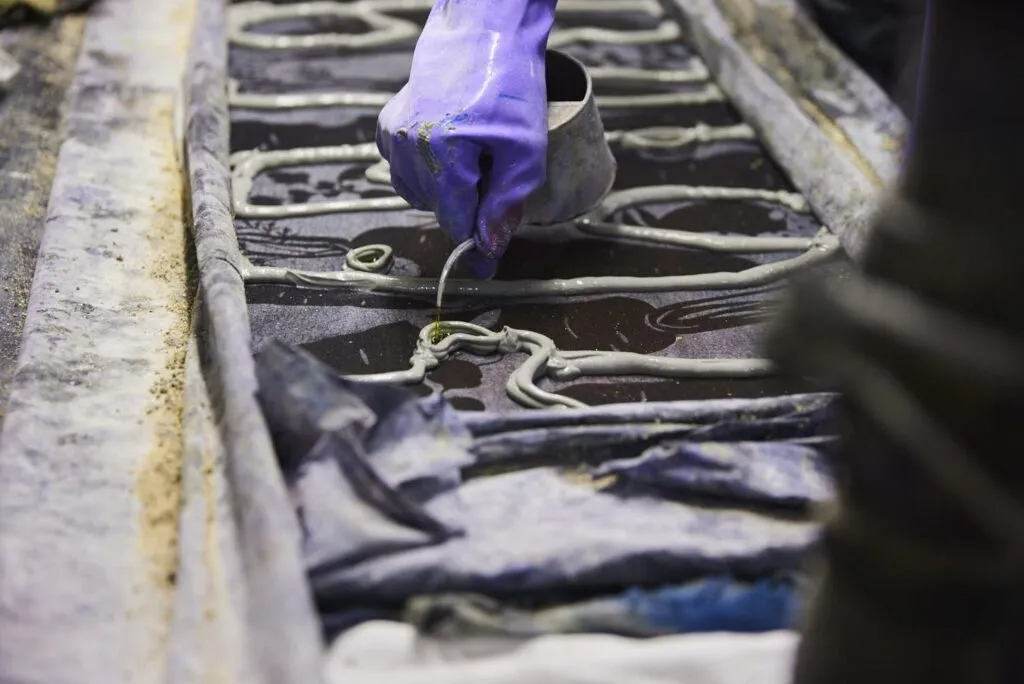
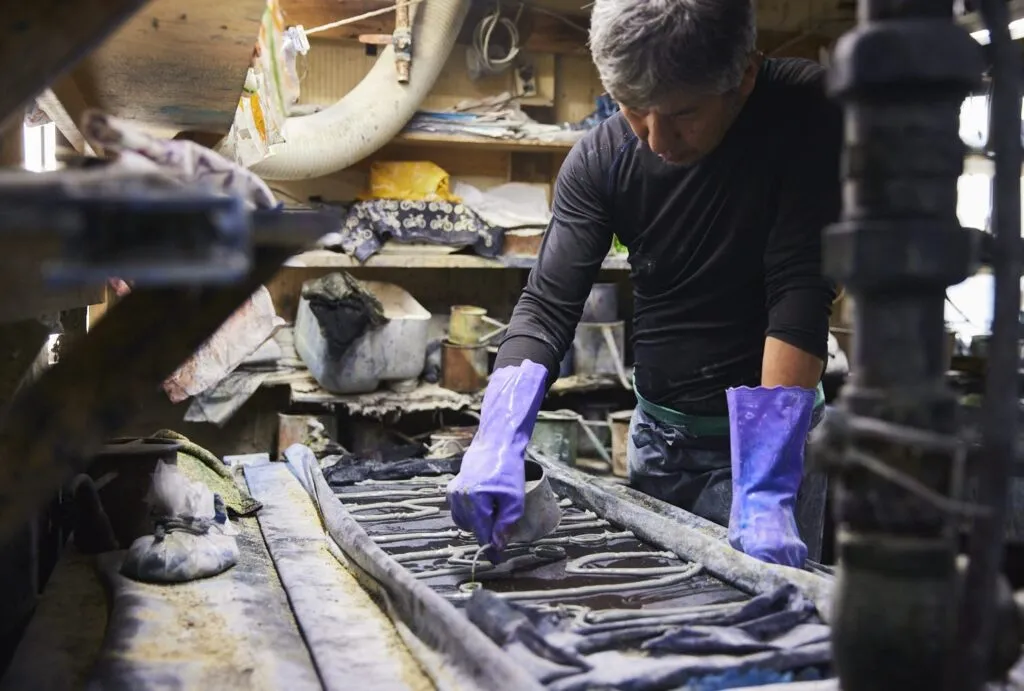
Next comes “dyeing.” Bundles of stenciled hand towels are placed on a dyeing table, and “dikes” are formed around the areas to be dyed, into which the dye is poured. The delicate blending of colors is a true testament to the artisan’s skill. Unlike printing or roll dyeing, which involves stamping patterns onto the fabric’s surface, this technique dyes the fibers themselves. To ensure the dye penetrates deeply, the artisan presses a pedal at their feet to draw the dye up from below.
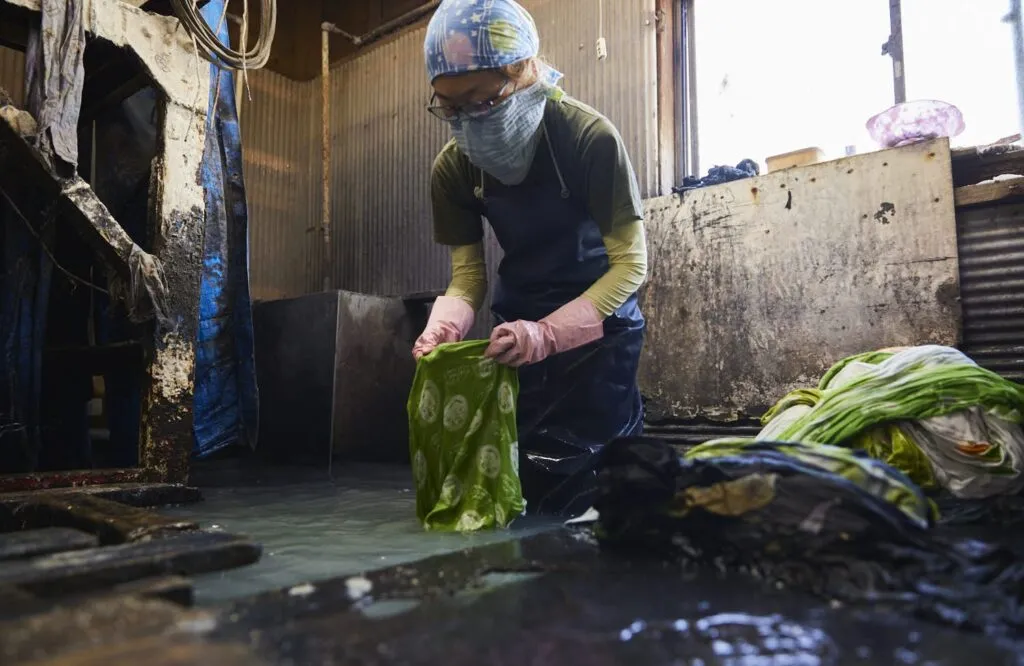
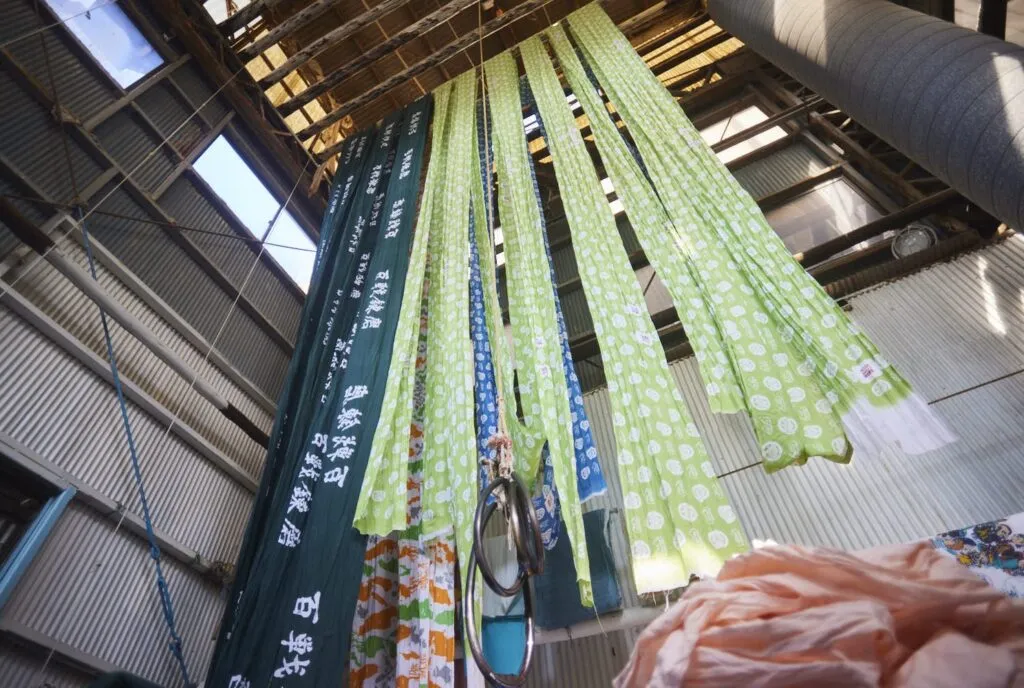
The dyed bundles of tenugui are then taken to the washing area inside the factory, known as the “river.” Craftsmen carefully wash each piece one by one to remove the resist paste applied earlier and any excess dye. After spinning them in a centrifuge to remove moisture, they are immediately sent to the drying room. The sight of the vividly dyed fabric—each piece over 20 meters long—fluttering in the breeze is truly spectacular. Since tenugui fabric dries quickly, it dries in just a few hours.
The “blurring” and “flickering” that embody the human touch and essence of Osaka
“Since Chusen is entirely handmade by artisans, no two pieces are exactly alike,” says Mr. Hisama. “The delicate, gentle gradations and blurring—a texture that can only be achieved through the artisan’s handiwork—truly embody the human touch that defines Osaka,” says Mr. Hisama.
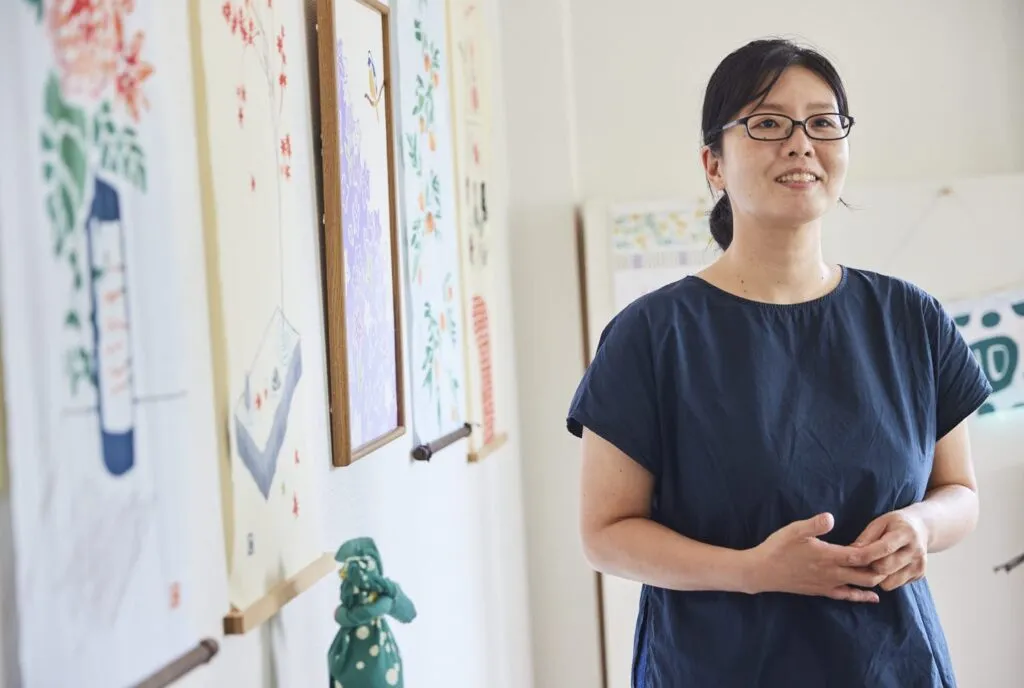
In 2008, Nakanai established “Nijiyura,” a brand specializing in chusen-dyed tenugui that incorporates these concepts of ‘blurring’ and “fluctuation” into its name. Currently, the brand operates four directly managed stores in the Keihanshin area and two in Tokyo, gaining fans both domestically and internationally.
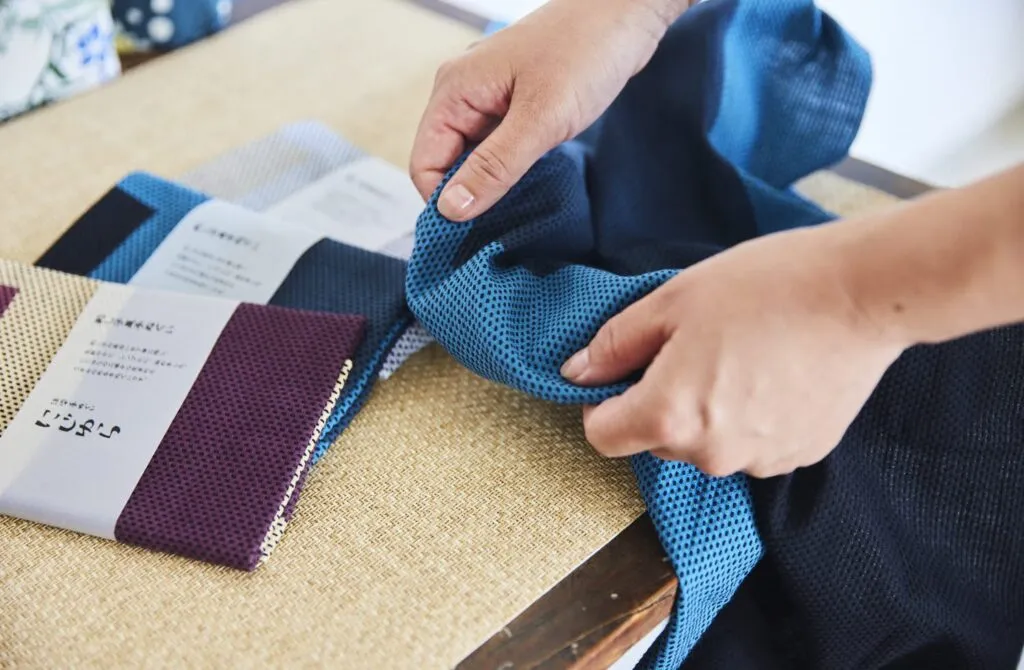
The “Sashiko-style Tenugui Mug,” which has been certified by the Sakai Kitchen Selection, is also an item from “Nijiyura.”
“Tenugui are so versatile that they’re often called ‘all-purpose cloth.’ In the past, this fabric was used for yukata; when it got old, it became a tenugui; when it wore thin, it was cut up to make straps for geta or zori; when it became tattered, it was used as a cleaning rag; and finally, it became a duster… It was a truly eco-friendly tool,”
As Ms. Hisama explains, the possibilities of the tenugui are endless. Moreover, the colorful and stylish tenugui from “Nijiyura” are sure to lift your spirits just by holding them. Let’s let our imaginations run wild and incorporate them into all sorts of situations.
Reporting & Text: Tomoyo Tsuchiya / Photography: Yutaka Sato